The monkey is reaching for the moon in the water.
Until death overtakes him he'll never give up.
If he'd let go the branch and disappear in the deep pool,
The whole world would shine with dazzling pureness.
[N]o other album, I believe, surpasses the audacity, the wonder, the desperation, and the joy of Astral Weeks. It is of all musical genres and of none at all, and its lyrics—with lines like “If I ventured in the slipstream/ Between the viaducts of your dream”—are as close as pop would ever get to closing its eyes and dreaming. For spiritual seekers, people willing to wander for a few decades in the desert because they know for certain that the promised land awaits, there can be no better companion than this record.
Lester Bangs, perhaps the finest rock writer who ever lived, was one of those seekers. “Van Morrison was twenty-two or twenty-three years old when he made this record,” Bangs wrote. “There are lifetimes behind it. What Astral Weeks deals in are not facts but truths. Astral Weeks, insofar as it can be pinned down, is a record about people stunned by life, completely overwhelmed, stalled in their skins, their ages and selves, paralyzed by the enormity of what in one moment of vision they can comprehend.”
I’ve gotten convinced that there’s something kind of timelessly vital and sacred about good writing. This thing doesn’t have that much to do with talent, even glittering talent. . . .Talent’s just an instrument. It’s like having a pen that works instead of one that doesn’t. I’m not saying I’m able to work consistently out of the premise, but it seems like the big distinction between good art and so-so art lies somewhere in the art’s heart’s purpose, the agenda of the consciousness behind the text. It’s got something to do with love. With having the discipline to talk out of the part of yourself that can love instead of the part that just wants to be loved.
This model is wrong
Although many scientific ideas generate conflicting results and suffer from falling effect sizes, they continue to get cited in the textbooks and drive standard medical practice. Why? Because these ideas seem true. Because they make sense. Because we can’t bear to let them go. And this is why the decline effect is so troubling. Not because it reveals the human fallibility of science, in which data are tweaked and beliefs shape perceptions. (Such shortcomings aren’t surprising, at least for scientists.) And not because it reveals that many of our most exciting theories are fleeting fads and will soon be rejected. (That idea has been around since Thomas Kuhn.) The decline effect is troubling because it reminds us how difficult it is to prove anything. We like to pretend that our experiments define the truth for us. But that’s often not the case. Just because an idea is true doesn’t mean it can be proved. And just because an idea can be proved doesn’t mean it’s true. When the experiments are done, we still have to choose what to believe.
Only idiots fail to contradict themselves three times a day.
— Friedrich Nietzsche

It's been a prevalent notion. Fallen sparks. Fragments of vessels broken at the Creation. And someday, somehow, before the end, a gathering back to home. A messenger from the Kingdom, arriving at the last moment. But I tell you there is no such message, no such home -- only the millions of last moments . . . nothing more. Our history is an aggregate of last moments.
 |
| Leaf Collage, Milvi Gill |
Nature is, above all, profligate. Don't believe them when they tell you how economical and thrifty nature is, whose leaves return to the soil. Wouldn't it be cheaper to leave them on the tree in the first place?
[T]here is a way that those cultural influences flow through all the people who do any kind of serious work anyway. So you can’t really tell: When I get it from J.G. Ballard, does that mean I got it from de Chirico, because Ballard couldn’t have done it without him? If you’ve got it going on, it all flows together.
 |
| Archimedes' Palimpsest |
Finally, we can't even conceive of a continuum of time. Every fragment exists by itself, and that's why we live among palimpsests, because finally all the work should fit into one whole, and express an entire perfect action, as Aristotle says, and it's impossible now, it's impossible, because of the breakage, there are pieces everywhere . . .
Seeing, according to Noë (2004), is like painting. Painting is an ongoing process in which the eye probes the scene, then flicks back to the canvass, then back to the scene, and so on in a dense cycle of active exploration and partial, iterated cognitive uptake. It is this cycle of situated, world-engaging activity that constitutes the act of painting. Seeing (and more generally, perceiving) is likewise constituted, Noë claims, by a process of active exploration in which the sense organs repeatedly probe the world, delivering partial and restricted information on a need-to-know basis. This cycle of situated, world-engaging, whole animal activity is the locus, on Noë’s account, of genuine cognitive interest, at least for perceptual experience. According to such a view, “Perception is not something that happens to us or in us, it is something we do” (Noë 2004, 1). Let’s call this the Strong Sensorimotor Model (SSM) of perceptual experience.
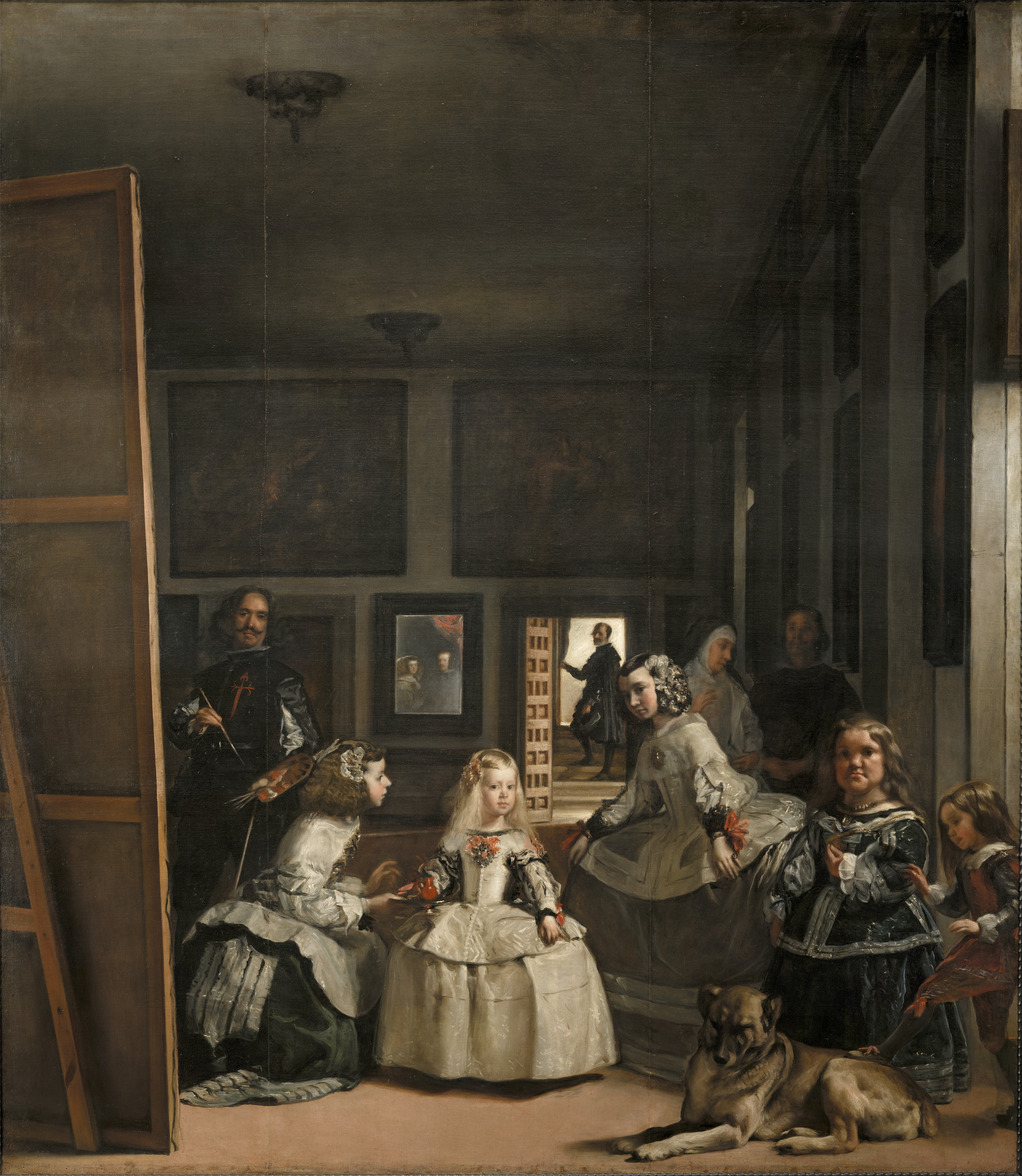
Velasquez, Las Meninas
The SSM does not merely claim that you need an active body as a platform for perceiving. Rather, the interesting claim is that skillful bodily action and perception are in some sense intimately entangled or intermingled. The starting point here is the correct and important observation that perception is active:
Think of a blind person tap-tapping his or her way around a cluttered space, perceiving that space by touch, not all at once, but through time, by skilful probing and movement. This is, or at least ought to be, our paradigm of what perceiving is. (Noë 2004, 1)
Expanding on this, Noë adds that
all perception is touch-like in this way: perceptual experience acquires content thanks to our possession of bodily skills. What we perceive is determined by what we do (or what we know how to do); it is determined by what we are ready to do . . . we enact our perceptual experience: we act it out. (2004, 1, emphasis in original)
An important implication of this, according to Noë, is that appeals to internal representations (if such there be) cannot tell the whole story either for painting or for seeing:
The causally sufficient substrate of the production of the picture is surely not the internal states of the painter, but rather the dynamic pattern of engagement among the painter, the scene and the canvass. Why not say the same thing about seeing? Seeing, on this approach, would depend on brain, body and world. (2004, 223)
 |
| Fragment of a previously unknown epic poem by Simonides about the Greeks’ victory against the Persians at Plataea |
The aim of this site is to experiment tools and devise methods for representing fragments of lost works, i.e. ancient texts that have survived only through quotations preserved by other authors.
Print collections of fragmentary texts are collections of textual excerpts drawn from many different sources and arranged according to various criteria, such as chronological order or thematic disposition. The length of these excerpts can be significantly different from one edition to another and depends on the editor’s choice. The aim of a digital collection of fragmentary texts is to go beyond the limits of print collections and express fragmentary sources in a more dynamic and interconnected way.